At a glance
Mold testing collects samples to answer a defined property question. It does not remove mold, locate every hidden problem or provide a universal pass/fail certificate. When growth is already visible, EPA says sampling is usually unnecessary. Ask what decision the result would change before commissioning a test.
Write the question before selecting a test
Begin by explaining the unresolved issue in plain language. You may be asking about a specific material, an unclear finding from an inspection or documentation requested by another party. Ask the assessor whether sampling can address that question and whether visual assessment or moisture investigation would be more useful. A test offered without a purpose may produce a number without helping you decide what to do next.
Identify who needs the information and how it will be used. A homeowner deciding on cleanup, a property manager arranging repairs and someone requesting completion documentation may require different deliverables. Ask the relevant party what report it expects before purchasing a package. Do not assume every laboratory result will satisfy a contract, building requirement or property transaction.
Record the question in the service agreement along with the assessor's proposed response. If no plausible result would change the next step, ask why the test is recommended. This does not mean sampling is never useful; it means the value should be explainable. Keep the distinction between identifying growth, interpreting property conditions and making personal health decisions, because a sample report cannot responsibly stand in for all three.
What air, surface and material samples can establish
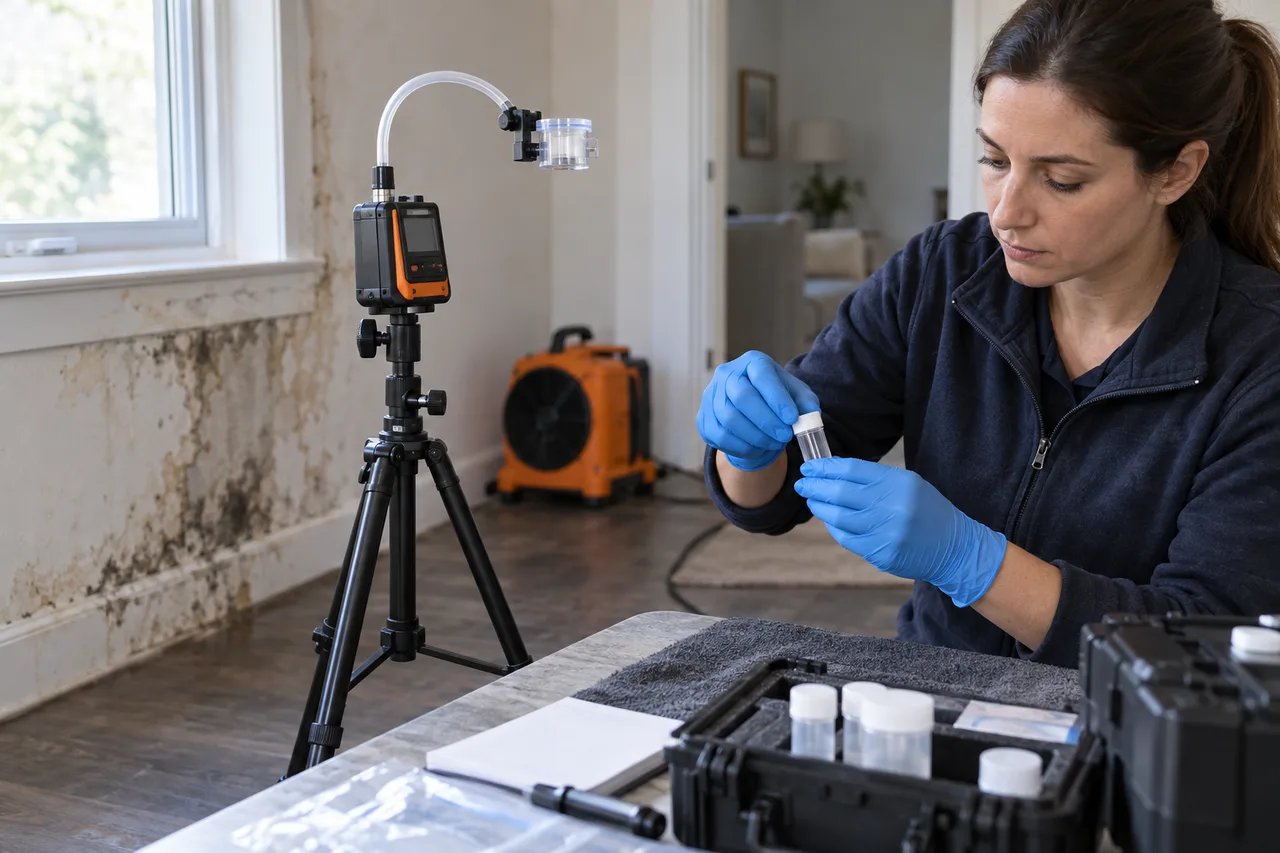
Different sample types answer different questions. An air sample characterizes material collected from air at a location during a particular sampling period. A surface sample focuses on a selected surface. A material sample concerns the submitted piece rather than every matching wall or floor in the property. Changing the method changes the question; a collection of tests is not automatically more useful than a smaller, properly designed assignment.
Sampling location, occupied conditions, equipment operation and recent cleaning can affect interpretation. These conditions belong in the report because a laboratory result detached from its collection context is easy to overread. A negative finding from one location does not establish that hidden areas elsewhere are unaffected. Conversely, a finding does not establish the full extent of building damage or tell a contractor exactly how much material to remove.
EPA states that visible mold usually does not require sampling and that no federal airborne mold thresholds have been set. Testing should therefore begin with a question whose answer will change a property decision. Possible assignments include characterizing a disputed surface or collecting evidence for an agreed post-work evaluation. The sampling professional must explain why the selected method is suitable, what the laboratory will analyze and what the results cannot establish. Testing does not replace source correction or a physical inspection.
Choose an assessor and clarify laboratory work
Ask who will design the sampling plan, collect the samples and explain the findings. Relevant experience should match the property question; a person simply delivering a kit is not necessarily providing an assessment. Request a clear description of qualifications and services without accepting an unsupported claim that every test is certified or government approved.
Confirm which laboratory will receive samples, how sample identities are recorded and what documentation accompanies the results. Ask whether the price includes collection, laboratory analysis, a written interpretation and a follow-up conversation. A laboratory sheet and a practical property report are different deliverables. If interpretation is an added service, know that before relying on the quoted price.
Discuss any relationship between the testing provider and a company recommending cleanup. A commercial relationship does not automatically invalidate results, but the homeowner should understand who is assessing, who is selling additional work and who is responsible for the report. Where another party requests independent documentation, clarify its requirements first. Avoid purchasing a test that fails to meet the intended recipient's needs simply because it is offered with a remediation package.
Read the laboratory result together with the collection report
A useful testing file has two parts: what was collected at the property and what the laboratory reported about it. Check sample identifiers, locations and collection dates against the site record before interpreting a result. If a sample label cannot be connected to a room or surface, the result may not help with the decision you commissioned. The assessor's interpretation should make that connection explicit rather than leaving the homeowner with unexplained numerical output.
Separate detection from extent, cause and health meaning. Those are not the same conclusions. Laboratory findings may describe the submitted sample, while an inspection describes accessible conditions and possible moisture sources. Neither should be silently expanded into a claim about every concealed cavity. A numerical comparison requires an explanation of the sampling design and its limits. There is no single federal pass-or-fail airborne mold number that makes this website able to certify occupancy.
The next action should follow the original question. A report may support further investigation, a defined removal scope or an agreed verification discussion; it may also leave a question unresolved. Repeating samples without changing the decision problem can add cost without useful information. Keep the complete laboratory and interpretation records for the professional carrying out subsequent work. Health symptoms and individual suitability for occupancy require appropriate health advice, not a conclusion inferred from a mold count alone.
Budget for the whole testing assignment
Compare the proposed visit, sampling plan and report rather than only the number of samples. More samples do not automatically produce a more useful answer. Ask why each additional location is included and whether the plan can change after the property inspection. Confirm the approval process for extra samples so the final invoice does not exceed the agreed scope without explanation.
Clarify attendance fees, laboratory charges, turnaround options, interpretation, travel and repeat visits. If results are time-sensitive, ask the provider for its actual reporting schedule and what could delay it. This website does not promise laboratory turnaround or contractor availability. Ask whether expedited reporting changes only delivery timing or also the content of the report.
Keep testing costs separate from cleanup, moisture correction and repairs. None of those tasks should be assumed to be included simply because testing is ordered through a restoration company. If a repeat visit is proposed after work, define its purpose and who will evaluate the results. An open-ended arrangement to keep testing until a preferred result appears is not a clear completion plan. Agree on the intended question and documentation at each stage.
Turn findings into a practical next step
When the report is delivered, ask what property decision it supports and what should happen next. The answer may involve further inspection, correction of a moisture source, a targeted cleanup discussion or no additional sampling for the current question. Request the reason for the recommendation. A report should help narrow uncertainty rather than automatically lead to every service a provider sells.
If you contact a remediation contractor, share the full relevant report rather than isolated numbers or a screenshot. Ask how the contractor's scope relates to actual affected materials and how any additional investigation will be authorized. If visible growth already defines the concern, discuss cleanup and moisture correction directly instead of assuming another round of sampling is mandatory.
Store the report with its date, property address, sampling map and related inspection records. Results reflect the assignment and conditions described, not every future condition in the building. If a new leak occurs, the earlier report does not eliminate the need to assess the new incident. ClearHaven's mold testing page is a decision guide for arranging a purposeful assessment; it is not a laboratory service, a safety certification or a substitute for the hired assessor's interpretation.
Match the evidence to the question
| Situation or stage | What it addresses | Important limit |
|---|---|---|
| Air sampling | Characterizes a collected air sample at a stated place and time. | Does not inspect concealed construction. |
| Surface sampling | Examines material collected from the selected surface. | Does not map the whole extent of affected materials. |
| Material sampling | Examines the submitted piece or specimen. | Does not establish that every similar material has the same condition. |
| Physical inspection | Documents accessible observations and moisture questions. | Does not automatically include laboratory analysis. |
Typical work sequence
- Write down the property decision the result must support.
- Agree on the sampling method, locations, reporting and total assignment cost.
- Have samples collected and analyzed by appropriately experienced professionals.
- Use the collection record and professional interpretation together to decide the next action.
The actual sequence depends on the assessed property and the hired contractor's written scope. These are planning stages, not an appointment or completion-time promise.
When to Discuss Mold Testing
EPA guidance says sampling is usually unnecessary when mold growth is visible. Testing may be useful for a specific assessment or documentation question, but an experienced professional should explain how the result would change the next step. Results must be interpreted with the sampling method, moisture history and property findings; they are not a whole-home safety certificate.
Signs Your Property May Need Attention
- Musty odor without a clear source
- Prior water damage with uncertain cleanup history
- A need for documentation before or after remediation
What the Service May Include
- Discuss sampling goals and limitations
- Collect samples when appropriate for the concern
- Compare results with visible moisture conditions
Benefits of Mold Testing
- Purposeful sampling may provide information for a specific property question when interpreted by an experienced professional.
- A written report can document the sampling locations, method and findings for later discussion.
- Agreeing on the testing objective helps the homeowner decide whether the additional cost is useful.
Limitations and Risks
- EPA says sampling is usually unnecessary when mold growth is visible. Testing should have a defined purpose.
- There is no federal airborne mold threshold that establishes a universal pass or fail result. A sample is not a whole-home safety certificate.
- Testing does not remove mold or correct moisture. Laboratory charges, interpretation and additional visits may be separate.
Questions Before Hiring a Contractor
- Why is testing being requested?
- Who will interpret the results?
- Will testing change the next step?
Costs and Work Terms
Pricing depends on the assessed property, affected materials, urgency, access and the contractor's written scope. Confirm any assessment charge, exclusions, payment terms, license and insurance before approving work.
Frequently Asked Questions
Do I need mold testing if I can already see mold?
Often not. EPA guidance says visible mold usually does not require sampling. Ask the assessor what decision the test would support before paying for it.
Does a mold sample prove the entire property is safe?
No. Results have to be interpreted with the sampling method, locations and property findings. Federal airborne mold limits have not been established, and a limited sample does not inspect every hidden area.
What should I receive after mold testing?
Ask for a report explaining the sampling objective, locations, laboratory findings, interpretation and limitations. Confirm who will explain the results and whether the fee includes a follow-up discussion.
Homeowner Resources
General AI-assisted homeowner guidance published by ClearHaven Restoration, a contractor-connection website, not a restoration contractor. References support the safety, sampling and equipment explanations; they do not certify this website or a contractor. This guide is not a property assessment. How this information is prepared.